
Stockholm’s Ski- & Snowboard School / Part of FriluftsfrämjandetWhere City Meets Slope: Building a Brand Identity for Stockholm's Local Ski School
Stockholm's Ski & Snowboard School had no brand of its own. Operating as part of Friluftsfrämjandet — one of Sweden's most trusted outdoor organisations — the ski school had always existed under the parent organisation's identity. But as they looked to grow, market themselves independently, and build a community of their own, that was no longer enough.
My task was to build their visual identity from scratch. Something that could stand alone, speak directly to modern Stockholmers, and still carry the trust and values of the organisation it belonged to.
I knew this world from the inside. I was one of the instructors.
My role
Art direction
Visual identity
Graphic design
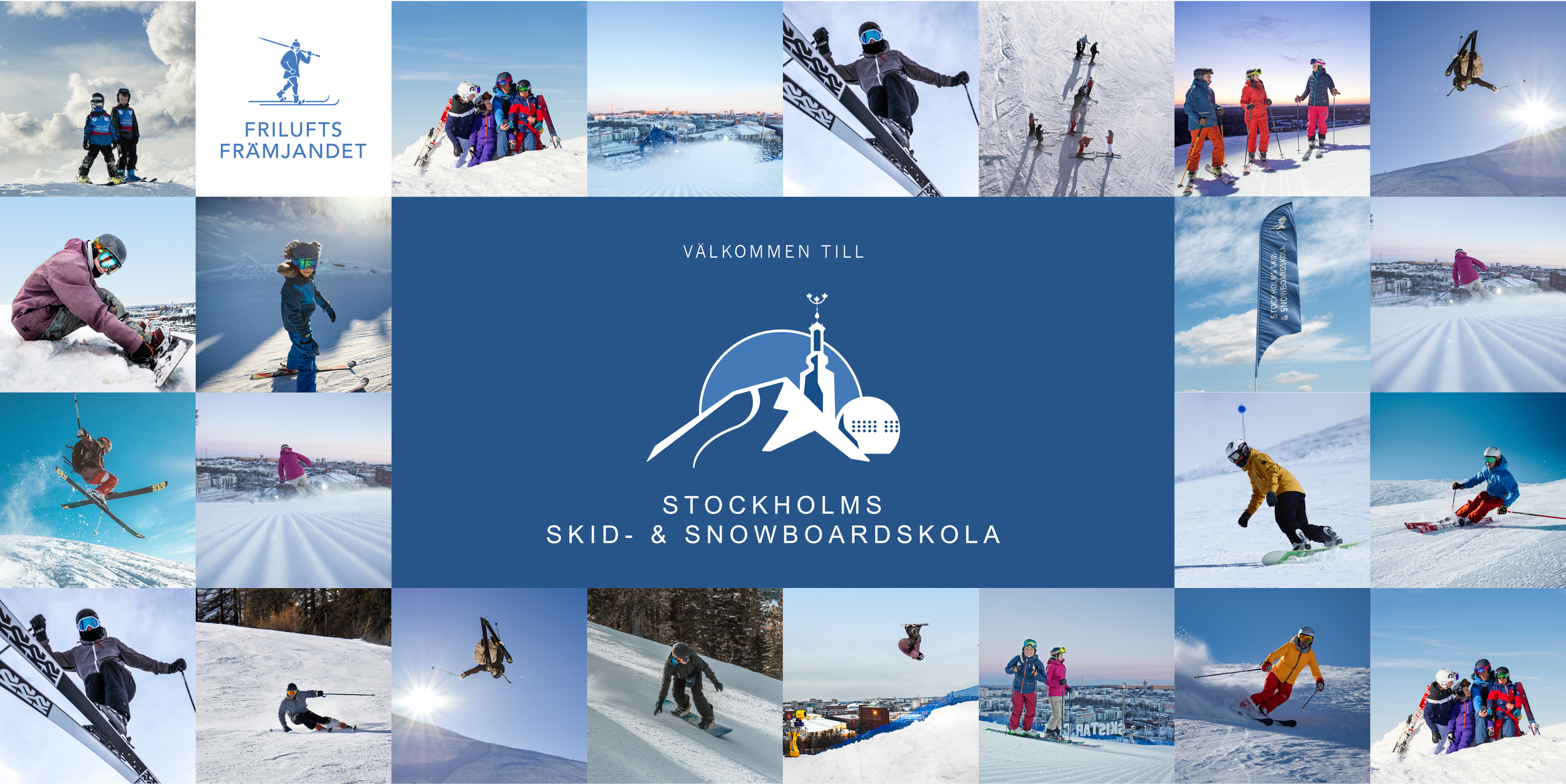
Where We StartedThe BriefCreative DirectionThe LogoRather than a generic ski or mountain mark, I incorporated two of Stockholm's most iconic landmarks directly into the logomark. The proximity to the city, the accessibility, the sense that this is Stockholm's ski school — all of it lives in the mark itself.
The ski school wanted to attract a specific but broad audience: active, city-loving Stockholmers who value both urban life and the outdoors. Families wanting their children to learn to ski early — ready for the bigger slopes on their annual ski holiday. Adults who never learned as kids and wanted to start now. All ages, all levels, all welcome.
The key insight was proximity. The ski school is located in the centre of Stockholm, making it genuinely accessible — a session after work, a weekend morning with the kids, no long journey required. That accessibility needed to be immediately legible in the brand.
The tension to navigate was a delicate one: create something distinct and modern enough to attract this audience independently, without severing the connection to Friluftsfrämjandet. That connection was not a constraint to work around — it was an asset. The parent brand carried decades of trust and credibility. The sub-brand needed its own personality while making that heritage visible.
The decision was to keep the foundations of Friluftsfrämjandet's brand largely intact — retaining the core colour palette and typographic style — and build on top of them rather than away from them. This preserved the visual family resemblance while creating enough distinction for the ski school to have a genuine identity of its own.
The central creative decision was the logo. Rather than a generic ski or mountain mark, I incorporated two of Stockholm's most iconic landmarks directly into the logomark: Globen and the City Hall. These are buildings instantly recognisable to any Stockholmer — their inclusion communicates the school's location and urban identity without a single word of copy. The proximity to the city, the accessibility, the sense that this is Stockholm's ski school — all of it lives in the mark itself.
To complement the logo and give the identity room to breathe across different formats and applications, I developed a series of illustrations in the same visual style — houses and urban elements that could function as standalone brand assets in communication, signage, clothing, and social media. The illustrative approach was a deliberate choice: playful enough to appeal to families and children, considered enough to feel modern and credible to adult learners and city-savvy parents.
The logomark places Stockholm's skyline at the heart of the ski school's identity. Globen — the spherical arena that is one of the city's most recognisable silhouettes — and the City Hall tower anchor the mark geographically and emotionally. You know immediately where this school is and what it stands for.
The illustrative line style keeps the mark approachable and warm, aligned with the spirit of föreningsliv — community-driven, open, and welcoming — while feeling fresh enough to stand apart from the more traditional visual language of the parent organisation.
Beyond the logo, a set of custom illustrations was developed in the same visual language — urban forms, houses, and architectural details that could be deployed flexibly across touchpoints. These gave the brand a toolkit to work with: elements that could appear on clothing, signage, social media, printed materials, and the website without requiring new creative development each time.
Having a library of on-brand illustrative assets is particularly valuable for an organisation run entirely by volunteers. It means anyone can communicate consistently without design expertise, and the brand remains coherent even when produced at low budget and high speed.
Illustrations & Brand AssetsThe identity was implemented immediately across all touchpoints — clothing, merchandise, signage, social media, and public communication. A website was also mocked up to complete the picture of how the brand would live digitally.
No formal metrics were measured — in an organisation run entirely on voluntary effort, that kind of tracking and added load simply isn't part of the culture, and it would be unreasonable to expect it. What can be said is that the identity was embraced immediately and enthusiastically by everyone in the ski school community.
Six years later, it is still in active use.
For a pro-bono project built on community values rather than commercial ambition, that kind of longevity speaks for itself. A brand that volunteers choose to keep, season after season, is a brand that works.
Project OutcomeA brand that volunteers choose to keep, season after season, is a brand that works.
Friluftsfrämjandet is an institution in Sweden. Founded on the principle that everyone should have access to nature and outdoor activity regardless of background, age, or ability, it is deeply embedded in Swedish culture — part of the beloved tradition of föreningsliv, where organisations run entirely on voluntary participation, with everyone contributing on equal terms.
The ski school operated on exactly these values. Every instructor, including myself, worked pro bono — receiving payment in the form of further training or ski trips funded by the organisation. It is a model built on community, shared passion, and the belief that outdoor sport should be accessible to everyone.
But without its own identity, the ski school was invisible as a brand. It had no logo, no visual language, no way of presenting itself to the modern Stockholm audience it wanted to reach. It was time to change that.